How to Dry Off a Dairy Cow Before Calving
If you are a beginner dairy cow owner curious about how to dry off a cow before she calves, this article is for you. There is a lot of uncertainty when you’re a new cow owner. But I want to assure you that drying off a dairy cow is not hard or complicated. Intimidating? Yes. But it’s not tricky or hard.
This post may contain affiliate links. Please read our disclosure policy.
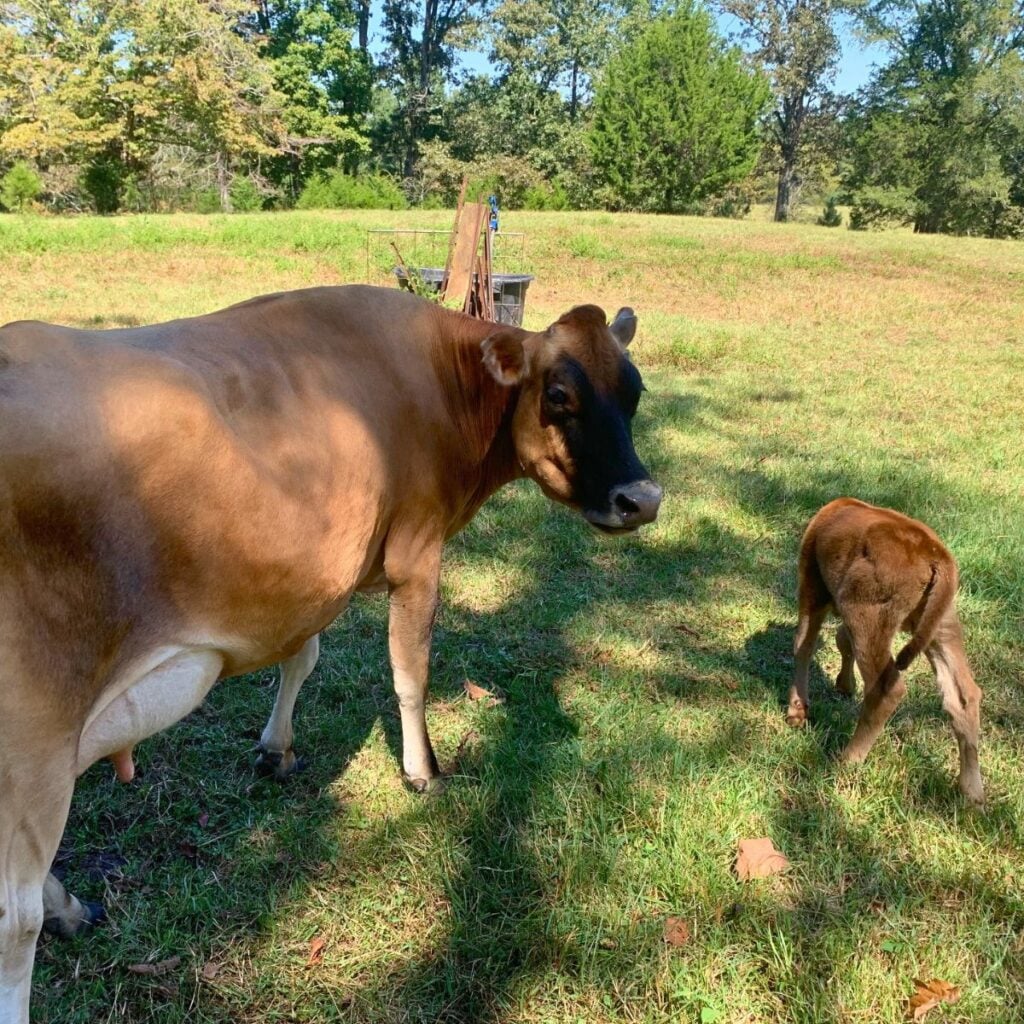
Congratulations on becoming a new cow owner! I was in your shoes when we got our first dairy cow. I was intimidated and worried that I would do something wrong or make horrible mistakes.
But don’t worry. There is hope for beginners! Give yourself grace as you learn the process of keeping a happy dairy cow. I’m sure you’ll be just fine!
How to Dry Off a Dairy Cow Before Calving
You should dry off your dairy cow at least 2 months before she calves. That way all her energy goes to producing a healthy baby instead of making milk. If you don’t dry her off, it will over-burden her body and she may get pretty scrawny. Then her baby calf growing inside her might be born with health issues.
We usually start drying off our cows 3 months before calving. Then they are fully “dry” by around 2.5 months.
It’s also helpful to mention here that we generally wean a calf off the mama between 6 months and her next calving date. What works for us is to put the calf in a separate pasture so it can’t nurse on demand.
Start milking once per day if you currently milk twice a day.
If you are currently milking twice a day, I would recommend starting the process of drying off your cow 3 months before her calving due date.
First, when you’re trying to decrease her milk production, don’t give her anything extra to eat except for what you normally give her in her stanchion during milking time. I would also omit feeding her barley, corn, wheat, oats, and other grains that are known to increase milk production. Stick to just alfalfa pellets or something similar.
Second, bring the two milking times together gradually.
For example, if you milk at 8am and 5pm normally, go at 8am and 4pm for a day. Then 8am and 3pm the next day, 8am and 2pm, and so on until you are just milking once a day at 8am. Whether it’s morning or night, choose whatever time is best for you…it works both ways.
Do once-a-day milking for a week or two, and monitor how much milk she’s producing. Be sure she’s just eating grass and/or dry hay when she’s not being milked. No extra treats.
Spread out once-a-day milking times to gradually dry her off.
When you’re ready to dry off your dairy cow for good before she calves, start spreading out your once-a-day milking times.
For example, if you milk her at 8am normally, go at 9am for a day. Push it to 10 am the next day. Go at 11am the following day, noon, and so on until you can skip a day.
A dairy cow’s milk production is all about supply and demand. If you and a calf don’t demand it, she won’t supply it.
You want to milk her out completely during this time, and continue to monitor how much milk she’s producing. Her milk supply will decrease remarkably fast.
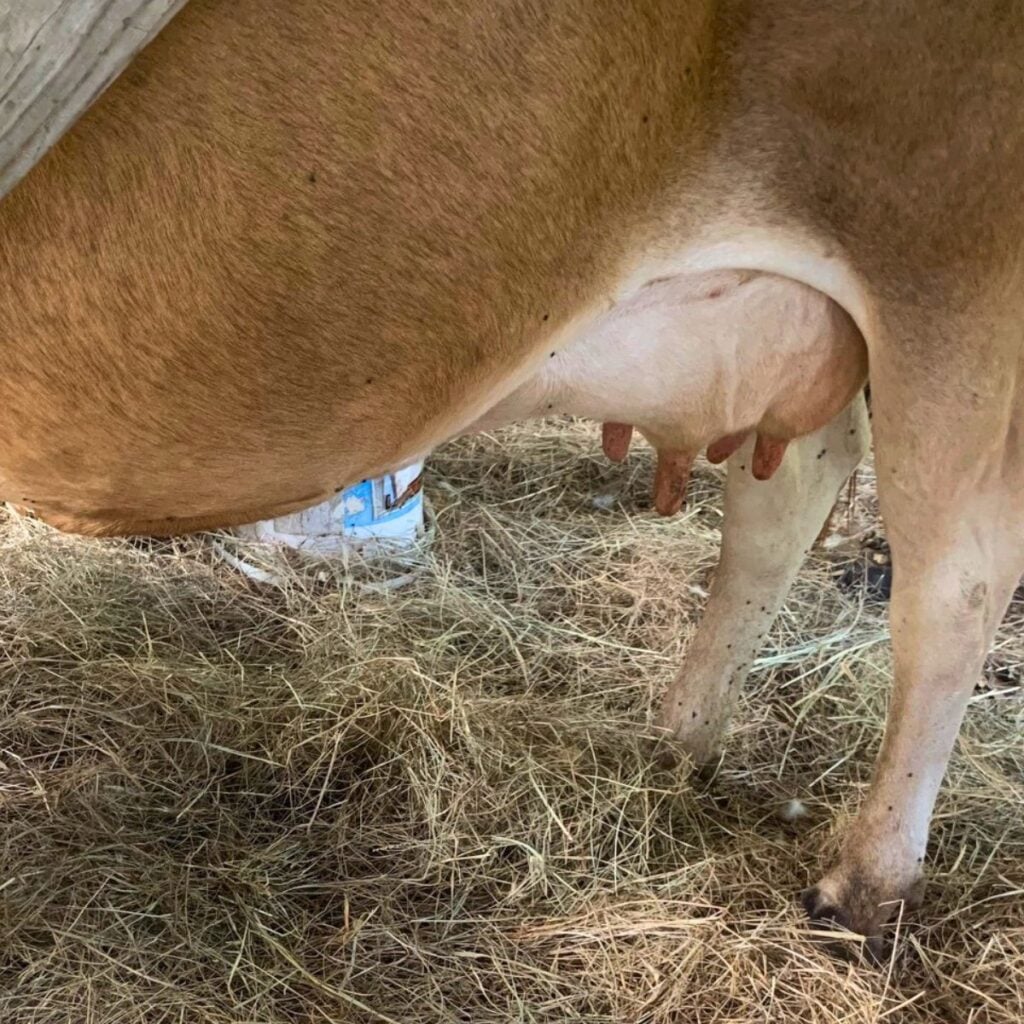
You’re ready to stop milking when she produces less than a gallon of milk.
We know we’re ready to stop milking when our dairy cow produces a gallon of milk or less per milking day. And we haven’t had mastitis develop.
Our process is that we will milk a day, skip a day, milk a day, skip a day. The milk production will gradually go down to one gallon or less. I want to mention here that our dairy cow usually produces 4 gallons of milk per day. That’s 2 gallons for us and 2 gallons for her calf.
If your dairy produces 8 or more gallons of milk per day, I’m not entirely sure that they will naturally go down to one gallon when you’re trying to dry them off. Leave a comment and let me know!
Check on your dairy cow regularly.
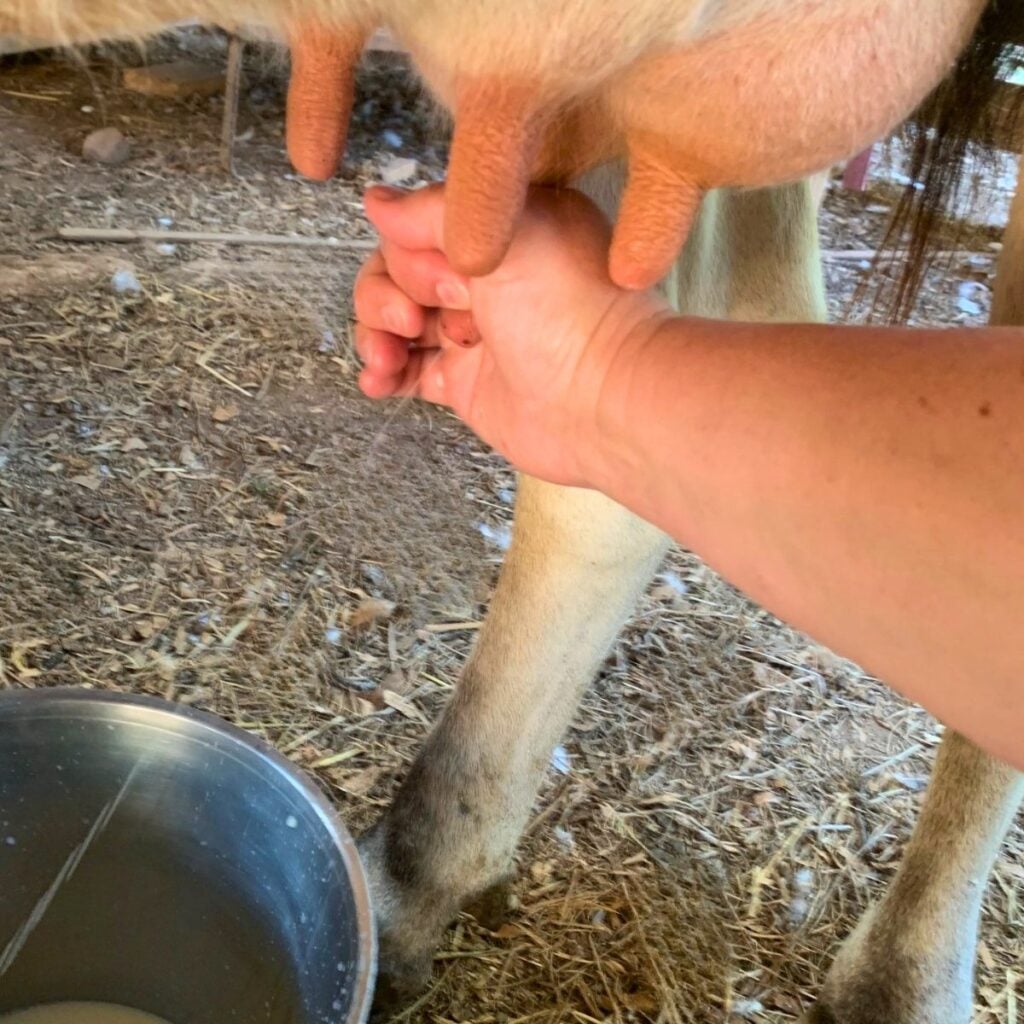
Your dairy cow’s udder should feel soft (not engorged with milk) when you’re ready to stop milking altogether. Gently touch her udder and teats to make sure it stays soft and not engorged.
Once you decide to dry her off completely, check on her every day and don’t do anything to stimulate milk production, like squeezing her teats to see if milk will come out, or brushing her udder, or putting her in the stanchion or wherever you used to milk her.
If you check on her and find her engorged with milk, milk her out completely. But the goal is to spread out the milking times until she stops being engorged with milk.
Then when she’s down to a gallon or less per milking time, you can quit and pretty much be assured that she will dry off on her own.
We usually continue to check on our dairy cows daily for about a week after we stop milking to make sure the udder feels soft and not engorged with milk. If a cow goes a week without being milked and their udder stays soft and not engorged, rest assured that the cow is drying up.
Do you need any medicine to dry off a cow?
We don’t use anything over-the-counter to squirt in the teats that dries off a cow and seals the teat to prevent mastitis. For us, natural, cheap, and old-fashioned is the best option.
The cows prefer us drying them off gently, too. If you’ve never had to insert a tube into a cow’s teats and squirt medicine before, trust me when I say they absolutely HATE it.
Commercial dairy farms do things differently…like use dry cow treatments. (Tubes, syringes, and squirty medicine.) But if you’re a backyard homesteader like us, and you’re not milking a lot of cows, I recommend following the simpler and cheaper method that we use.
Tips
Note About Mastitis – If you are milking once per day, and you are milking your dairy cow out pretty completely, you don’t have to worry about mastitis.
Additionally, when you proceed with skipping days between milking to decrease your dairy cow’s milk production, you don’t have to worry about mastitis.
Just be sure your cow has clean pasture to sleep on and that she’s not laying in a filthy area where the bacteria from the filth can enter her teats and cause mastitis. What works for us is to shut our barn stalls and force our cows to sleep in the pasture where there’s more than enough room to roam and not get muddy or dirty.
Give yourself plenty of grace and trust the process.
Remember that you are drying off your cow so that all her energy goes into producing a big and healthy baby calf. Any hassles and hiccups will be well worth it once you get a new baby on your farm.