
Homemade Muscadine Jelly Recipe: A Southern Delight
There’s something utterly magical about turning a basket of plump, sun-ripened muscadine grapes into a jar of jewel-toned homemade muscadine jelly. As someone who’s spent countless afternoons in a bustling kitchen, surrounded by the laughter of family and the sweet aroma of simmering fruit, I can tell you that this muscadine jelly recipe is more than just a set of instructions. It’s a celebration of seasonal bounty and timeless traditions.
This guide will walk you through crafting your own batch of muscadine jelly that’s perfect for slathering on biscuits, gifting to friends, or elevating your charcuterie board. And if you will be water bath canning for the first time, this is an easy homemade jelly recipe that’s perfect for beginners!
This post may contain affiliate links. Please read our disclosure policy.
Muscadine grapes grow in wooded areas and are native to the southern states in USDA Hardiness Zones 7 to 10. We were lucky to discover a wild muscadine vine growing near our barn this year, so we took full advantage. Since the vine was growing high in the trees, we had to bring out a ladder to reach most of the grapes.

Muscadines are not your average grocery store grape, though. Depending on the variety of muscadine local to you, some are either a deep purple grape (traditionally called “muscadines”) while others can be green, bronze, or white (also called “scuppernong grapes” and “big white grapes”). Muscadines have thick skins and seeds and they boast a deep, concentrated flavor that’s equal parts sweet and tart.
When you pick these wild grapes in late summer, be sure to let them sit on your counter for a few days or a week to soften a bit because they are pretty firm right off the vine. But the color should be fully developed and it should smell like a very concentrated grape. In fact, when you turn the purple muscadines into grape juice to make jelly, it makes your kitchen smell like communion!
This muscadine jelly recipe transforms the grapes into a spreadable treasure that’s versatile for breakfast spreads, dessert glazes, or even savory pairings like cheese platters. Let’s get started on this delightful journey!
Homemade Muscadine Jelly Recipe
A great muscadine jelly recipe starts with quality ingredients, and this one keeps it straightforward while allowing room for refinement.
Ingredients
Muscadine grapes – These can either be room temperature or frozen. A mix of bronze and purple grapes make a delightful color, but use what you have.
Granulated sugar – I like using organic sugar for a subtle caramel note. Avoid artificial sweeteners or use an approved recipe developed by expert canners and food safety experts. The recipe I’m sharing is similar to the one found in the Preserving With Pomona’s Pectin cookbook for grape jelly, but altered to use muscadines.
Disclaimer: The Pomona’s Pectin cookbook recipe is a reduced-sugar recipe. If you like a sweeter muscadine jelly, you may wish to increase the amount of sugar called for in the recipe below by adding another cup or two. Taste the juice as you go, and add more sugar to taste.
Fresh lemon juice – Avoid using the bottles of lemon juice sold in the grocery store. Those often include other ingredients to make it shelf stable and I haven’t ever found one where I enjoyed the taste. Fresh or frozen lemon juice is best.
Water – To make the grape juice.
Package of Pomona’s pectin or Certo – For reliable setting in this easy muscadine jelly recipe. I prefer using the Pomona’s box of pectin because it decreases the amount of sugar needed for jelly recipes.
Apple scraps – This is optional, but if you don’t have enough muscadines to make your juice, you can add some apple scraps that you’ve stored in your freezer to not only add more pectin, but to increase the amount of juice you’ll get. The grape flavor will overpower any apple juice flavor that you may otherwise detect, so don’t worry.
That’s it! No fancy additives here. This muscadine jelly recipe relies on the grapes’ natural pectin boosted by the commercial variety for foolproof results.

This post contains affiliate links, which means I make a small commission at no cost to you. See my full disclosure here.
Tools You May Need
Measuring cups and spoons
Large saucepan with lid
Water bath canner and canning rack
Half-pint and half-gallon canning jars
Flour sack towels, thin tea towels, or jelly bags
Wire whisk
Medium pot
Spatula
Funnel
Ladle
Dish towels and rag
Step-by-Step Guide to Making Muscadine Jelly
Now, the heart of our muscadine jelly recipe: the step-by-step process. You can split the work up by making fruit juice one day and making a batch of jelly the next day. That’s what I tend to do.
Step 1: Turning the Muscadine Grapes into Grape Juice
Begin by removing the stems and washing your muscadine grapes under cool running water. Put them in a large measuring cup or measuring bowl to see how much volume you have. Then fill a separate measuring cup with an equal amount of water.
I had eight cups of muscadines so I got eight cups of filtered water ready in order to make multiple batches of jelly. However, if you’re following the attached recipe card exactly, you only need 5 cups of muscadines and 5 cups of water in order to get 5 half-pint jars of jelly.

In a large stockpot, add the grapes and water and bring to a boil over high heat. Then reduce the heat, cover, and simmer for 10 minutes, stirring occasionally.
Scrape off any foam that rises to the top the best you can.

As the grapes soften, they’ll burst, releasing their juicy interiors. This is where the magic happens in your homemade muscadine jelly recipe. The kitchen will fill with a sweet, vineyard-like aroma that reminds me of summer days on the farm…or church communion.
When the timer goes off, turn off the heat and mash the grapes with a potato masher to release every drop of flavor.

Then, strain the mashed fruit mixture through a dampened cloth jelly bag or dampened flour sack towel into a large measuring cup or bowl.

Prepare a slip knot with some kitchen string, gather the edges of your towel up and through the slip knot, and hang it over a bowl in your kitchen to let the juices drain out for at least 2 hours.
Jelly Making Tip: Don’t press or squeeze the juice out hard or you’ll make your jelly cloudy. Letting the juice drip out naturally creates a clear jelly.

Let the juice sit for a few hours or overnight in the fridge to allow sediment to settle at the bottom of your jar. This step ensures your muscadine jelly recipe yields a crystal-clear product.
Step 2: Making the Muscadine Jelly
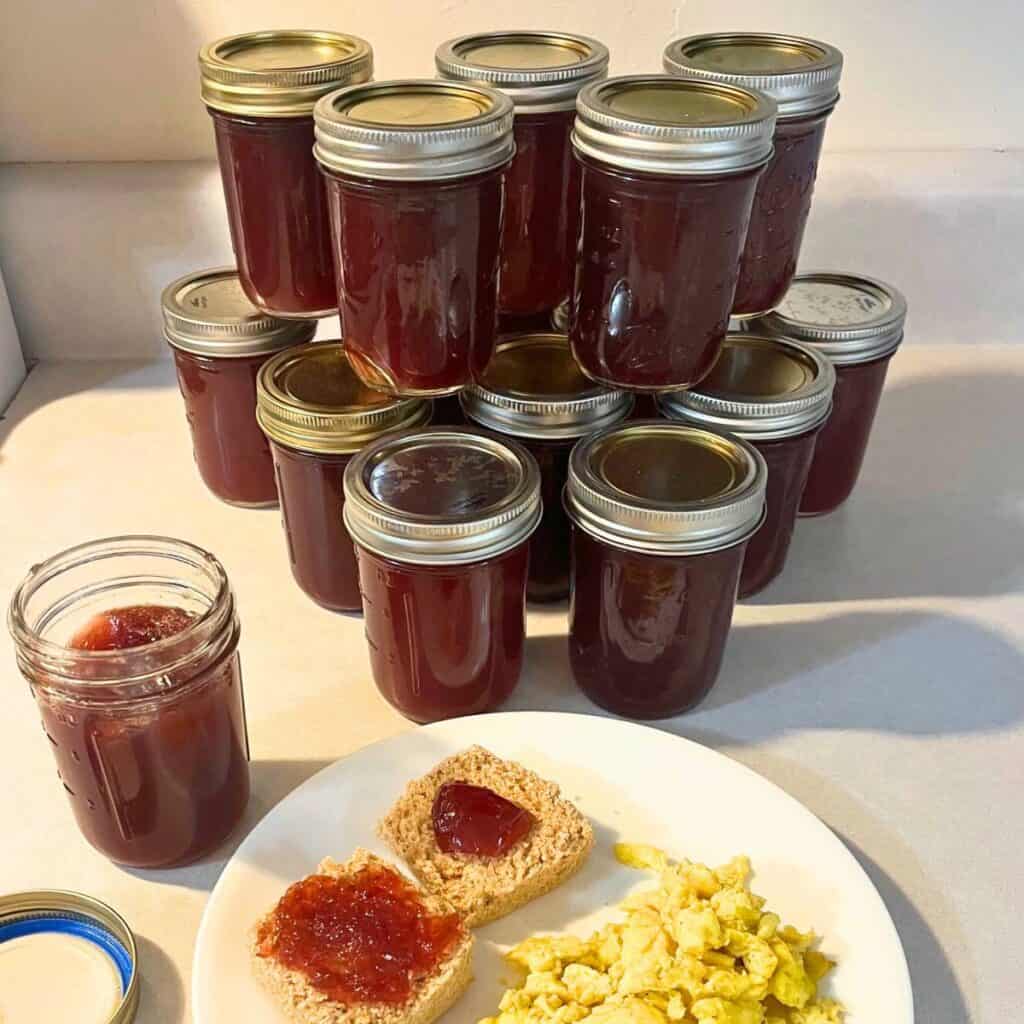
This recipe makes 5 half-pint jars of homemade muscadine jelly.

Here’s what you’ll need:
- 4 cups of muscadine juice (plus a smidge more for good measure to fill all 5 half-pint jars)
- 1 cup of granulated sugar (and up to 2 cups more, to taste, if you like sweeter jelly)
- 1/2 cup of water (for making the calcium water; you won’t add all of this mixture to your jelly recipe, though)
- 1/4 cup of lemon juice
- box of Pomona’s pectin

First, make the calcium water using the powdered calcium inside your box of Pomona’s pectin. In a small jar, combine 1/2 cup of water and 1/2 teaspoon of calcium powder. Mix together well and set aside.
You won’t need the entire amount for your jelly. Label and store this calcium water mixture in your refrigerator and use it up within 6 months.
Measure out 4 cups of the strained muscadine grape juice plus a smidge more into a clean, large pot. Make sure to avoid adding the sediment that has settled in the bottom of your jar.
Then add 4 teaspoons of the calcium water mixture you previously prepared and 1/4 cup of fresh lemon juice to your pot. Mix together well. This acidity not only brightens the flavor but aids in setting the jelly.

Bring the mixture to a full rolling boil over high heat, stirring occasionally. A full rolling boil means bubbles that don’t stop when stirred, which is essential for any jelly recipe success.
In a separate bowl, mix together 1 cup of sugar (and up to 2 more cups of sugar, to taste, for sweeter jelly) and 4 teaspoons of Pomona’s pectin powder (also included in the box). Set aside.

Once the grape juice mixture is boiling rapidly, stir with your wire whisk and add the sugar and pectin all at once. Stir vigorously for 2 minutes until the sugar dissolves completely. Your arm will get a workout here!
This timing is crucial. If you underboil, your homemade muscadine jelly might not set. If you overboil, it could turn syrupy.

When the timer goes off, remove from heat and skim off any foam.
Test the gel by placing a small plate in your freezer for several minutes. Then take it out and drop a spoonful of muscadine jelly in the center. Put the plate back in your freezer for 1 minute, then take it out and push the mixture.
If it wrinkles when you push it, your jelly is perfect. If it doesn’t wrinkle, boil the jelly for another 30 seconds and re-test.
Step 3: Canning Your Muscadine Jelly
Prepare your workspace with sterilized jars, lids, and any large pot big enough to water bath can.
Safety first: Always use proper canning techniques to preserve your homemade muscadine jelly for up to a year and eliminate the risk of food poisoning.
To do this, I like to put my bands and lids together in a medium saucepan of water and simmer over medium heat.

Then fill your canner about halfway with water and submerge your canning jars so that they are covered by at least 1 or 2 inches of water. Simmer over medium heat.

The ideal for any jam or jelly recipe is to have the jars, lids, bands, and jelly mixture to be about the same hot temperature.
Next, ladle the hot jelly into sterilized half-pint jars, leaving 1/4-inch of headspace at the top.

Wipe the rims clean with a damp cloth to ensure a good seal. Also, run your finger around the rim to make sure there are no cracks or chips that would prevent your lids from sealing properly.
It turns out that I didn’t get all the foam off my jelly, but they turned out fine anyway after processing.

Next, place the lids on and screw on the bands to fingertip-tight. This means that you tighten the ring until it just meets resistance, and then tighten it about a fingertip width more.
Don’t crank down or overtighten your jar lid or else your jars may explode in your canner.
Then use your jar lifter to set the hot jelly jars into your hot water bath canner using caution to not get burned.

Put the lid on your water bath canner, turn the heat on high, and let the water come to a rolling boil. Once you see the water boiling, put the lid on your canner and process your jars for 10 minutes, adjusting for your altitude. (To adjust for altitude, read my notes down below.)
If you have more muscadine grape juice, get another batch of jelly cooking on your stove. I make multiple small batches at a time, which always gives me the best quality.
When the canner timer goes off, turn off the heat and let your canner sit undisturbed for 5 minutes. Then remove the lid carefully to avoid steam burns, use a jar lifter to remove your hot jars of jelly, and let them cool on a towel on your counter for 12 to 24 hours.
Listen for the satisfying “pop” of sealing lids. It’s the soundtrack of a successful muscadine jelly recipe!

The next day, make sure that the jars have sealed properly by removing the bands and making sure the lids are sealed on. To do this, I will lift up the jar by the edges of the lid and if the jar comes up with it, I know the jars are sealed properly. If any jars don’t seal, refrigerate them and use within a month.
Properly sealed jars can store in a cool, dark place for up to 12 months and maybe even longer. Once opened, refrigerate. Jelly will often keep for up to a year unopened, sometimes longer depending on conditions. Once opened, it might last a few weeks in refrigeration.
Adjust for Altitude
The boiling point of water is different depending on your altitude, and the processing time also varies. Water boils at 212°F (100°C) at sea level, but it boils at 1°F lower for every 500 feet in elevation that you go up.
- If you are at sea level up to 999 feet in elevation, process your jars for 10 minutes.
- If your elevation is between 1,000 feet to 1,999 feet, process your jars for 11 minutes.
- If your elevation is between 2,000 feet to 2,999 feet, process your jars for 12 minutes. And so on.
If you don’t know your elevation, check with your county extension office for guidance or use Google to search for your city or county elevation.
Tips for Perfect Muscadine Jelly Every Time
Even with the best muscadine jelly recipe, a few insider tips can elevate your results. Here are some of the things I’ve learned.
Taste the grapes first. If they’re underripe, overly tart or sour, the jelly will need more sugar or some blending with riper fruit. Overripe, they can get mushy or even ferment. Let your grapes sit on your counter for several days to ripen and sweeten if they are underripe.
Skin/seed handling. Seeds are bitter if crushed too much and the skins contribute to the color and flavor. If you want ultra‑clear jelly, use a cloth jelly bag or flour sack towel and don’t force or squeeze the juice out. If you like some texture, incorporate more pulp.
Temperature is key. That 220°F mark is what tells you the sugar‑juice‑acid balance has reached jelling. Without a thermometer, freeze a plate, drop a spoonful of jelly on the cold plate, and stick it back in the freezer for 1 minute. When you take it out, push the jelly on the plate. If it wrinkles when pushed, it’s ready. If it doesn’t wrinkle, let the mixture boil for another 30 seconds and re-test.
Sugar proportions matter. Too little sugar and your jelly won’t set well; too much, and it may be too stiff or overly sweet. Sugar also helps preserve.
Don’t rush sterilization. Clean jars, lids, and bands make a difference. Yeast or bacteria in jars can spoil your jelly.
Altitude adjustments. Boiling points change with elevation. If you’re high up, your water boils at a lower temperature and you will need longer processing times or boil times. Check your local extension guidelines.
Storage-wise, add a cute jar label and write the date.
Troubleshooting: If your jelly is too firm, next time reduce the boil time slightly. Too runny? Increase pectin, sugar, or boil time. Also, weather can affect the final product. Humid days might require extra time.
Recipe Card

Classic Southern Muscadine Jelly Recipe
Equipment
- water bath canner
- half pint canning jars, lids, and rings
- jar lifter
- lid lifter
- measuring cups and spoons
- large and medium saucepans
- funnel
- wire whisk
- ladle
- potato masher
- jelly bag or flour sack towel
- large bowl
- kitchen towel and dish cloth
Ingredients
- 5 cups muscadine grapes, washed with stems removed (fresh or frozen)
- 5½ cups water, divided
- 1 cup granulated sugar
- ¼ cup fresh lemon juice
- 1 box Pomona's pectin
Instructions
Make Muscadine Juice
- Pour 5 cups of muscadines and 5 cups of water in a large saucepan and bring to a boil over high heat. Once boiling, reduce heat, cover, and simmer for 10 minutes. Stir occasionally.
- Remove from heat and mash grapes.
- Line a large bowl with a dampened jelly bag or flour sack towel, and pour the muscadines and juice in.
- Make a slip knot with kitchen string, gather the edges of the jelly bag or flour sack towel, slip the edges through the slip knot, and hang over a bowl to drip for 2 hours.
- Refrigerate the juice overnight to let the sediment settle at the bottom.
Muscadine Jelly Recipe
- Prepare Pomona's calcium water by mixing ½ cup of water with ½ teaspoon of calcium powder. Stir and set aside. You won't need to use all of this and the extra calcium water can be labeled and stored in your fridge for future use. Use within a few months.
- Fill a water bath canner (or large pot with a rack at the bottom) half way with water and submerge 6 or 7 half pint canning jars. Sterilize the jars by bringing the water up to a simmer. Also, bring a separate saucepan filled with water, the canning jar lids, and rings to a simmer.
- In a medium saucepan, combine 4 cups of muscadine juice (plus a smidge more), ¼ cup of fresh lemon juice, and 4 teaspoons of calcium water. Whisk well and bring to a rolling boil over high heat.
- In a separate bowl, mix together 1 cup of sugar and 4 teaspoons of Pomona's pectin. Set aside.
- When the muscadine juice mixture is boiling rapidly, add the sugar and pectin mixture and whisk vigorously for 2 minutes until all the sugar is dissolved. Your arm will get a workout! When the timer goes off, remove from heat.
- Set your sterilized canning jars on a kitchen towel. Ladle hot jelly mixture into your hot jars leaving ¼ inch of headspace at the top.
- Wipe the jar rims clean and make sure there are no nicks or cracks that would prevent your jar from sealing properly. Then use a magnetic lid lifter to add the lid and ring to the jar. Tighten the ring until it's fingertip tight. That means that when you first meet resistance screwing on the ring, tighten a fingertip width more. Avoid over-tightening or your jar will crack during processing.
- Use caution and a jar lifter to submerge the hot jars into the hot water bath canner. Add the canner lid and bring the water to a boil.
- When the water is boiling rapidly, add the canner lid and set a timer for 10 minutes (adjusting for elevation) to process your jars.
- After 10 minutes, turn off the heat and let the canner rest undisturbed for 5 minutes.
- After 5 minutes, carefully remove the canner lid to avoid steam burns, and remove the jars with your jar lifter. Place the hot jars on a kitchen towel and allow to cool down for 12 to 24 hours. Listen for the satisfying "pop" of the lid, which signals that your jars have sealed properly.
- When your jars have cooled down completely, remove the bands, check that the lids sealed properly, and then label and store your jars in a cool, dark place.
Serving Suggestions: From Casual to Chic
Slather muscadine or scuppernong jelly on warm biscuits or pair it with artisanal cheeses and crackers. There’s also the classic family favorite of peanut butter and jelly sandwiches, made better if you put it on fresh homemade bread.
Use it as a glaze for roasted meats by brushing it on chicken or pork for a sweet-tart kick. In desserts, swirl into yogurt parfaits, top cheesecakes, swirl into a tart, fold into cream cheese frostings, use as an under‑layer in a trifle, or make thumbprint cookies. For a personal and elegant gift, tie ribbons around jars and include your muscadine jelly recipe card.
Health Benefits and Nutritional Notes
Beyond taste, muscadine jelly offers nutritional perks. Muscadines are rich in ellagic acid, which may have anti-cancer properties, and their skins contain fiber for digestion. While jelly is sugary, moderation makes it a treat.
Variations on the Classic Muscadine Jelly Recipe
To keep things exciting, you can tweak this base muscadine jelly recipe. Here are some variations you might try.
Muscadine Pepper Jelly: Add diced bell pepper, maybe some red pepper flakes or a dash of crushed red pepper. Adds wonderful heat and savory contrast.
Lemon Scuppernong Jelly: Use golden scuppernongs, lemon zest, and more lemon juice.
Spiced Muscadine Jelly: Consider adding touches of vanilla bean, cinnamon, or even star anise as the jelly cooks. Strain out solids for smoothness.
Herbed Jelly: A sprig of rosemary, thyme, or basil added during soaking / cooking can infuse subtle herbal undertones. Remove before jelling.
Final Thoughts: Why Muscadine Jelly Is Worth the Effort
The work of making this jelly…the picking or buying good muscadines, the cooking, the straining, the canning…is a labor of love. But once you taste that golden or violet jelly glistening in the jar, you’ll see why people make this type of grape jelly year after year.
Additionally, sharing something homemade and heartfelt is the kind of thing that feels just right. So roll up your sleeves, wash your jars, get your candy thermometer (or cold plate) ready, and let’s make some muscadine jelly. And trust me…when you open that first jar, you’ll feel like you’ve made something small but wonderful.
Shop This Post!
Preserving With Pomona’s Pectin cookbook
Pin It For Later


It is so neat that you have wild grapes! We make jam with wild blackberries, but these grapes look HUGE and delicious. Thanks for teaching me about a type of grape I had no idea existed!
Thanks Meghan! And you’re so welcome! Wild blackberry jam is one of our favorites, too.
Love, Rebekah
Ive never heard of muscadine grape before! Thank you for sharing. My husband loves jelly.
Hi Kayla, You are very welcome!
Love, Rebekah
What a delicious recipe! I have wild grapes growing everywhere in the woods around my place, but haven’t had time yet to check what they are. I’m probably too late now. I wonder if they are muscadines, but I’m in zone 6b in Missouri. So that’s probably too cold for them. Now I wished I had checked. I’m new to this area and am totally planning to grow grapes, but I do plan to use any wild ones I find too once I get myself a bit settled in. Thanks so much for sharing this recipe. I’ll certainly want to try it if I can get my hands on some of these muscadines!
Hi Heidi, How neat! Good luck on next year’s grape harvest!!
Love, Rebekah
I had to comment because I LOVE muscadine anything!! I can’t wait to try this! Thanks for sharing!
Hi Kelly, Same! I hope you enjoy it!
Love, Rebekah
Yum, great recipe!! Grapes jelly is one of my favorite, I wished they grew more easily where I live 🙂
I had never heard of these grapes before but now I want to try them! This recipe sounds delicious!
Hi Hailey, Thank you and I hope you do get the chance to try them!
Love, Rebekah
Have you ever doubled this recipe? Much obliged!
Hi Jimmie,
I make a double or triple batch of muscadine grape juice the day before I make jelly. However, I only make jelly one recipe at a time. I found out years ago that cooking small batches of jelly and preserves gave the best quality. Another reason that I make jelly one recipe at a time, especially for this muscadine jelly, is that it’s very quick to make it. I just re-use the pot and containers for the next batch of jelly and keep going. If you double the jelly recipe and like how it turns out, please let me know!
Love, Rebekah
Rebekah in step one you said you had 8 cups of muscadines and used 8 cups of water but in the recipe you said 5 cups of muscadines and 5 cups of water. I followed the recipe, 5 cups water and muscadines, which yielded 5 half pints, and my jelly turned out kinda bland. I looked at a lot of other recipes that use pectin and most of them use 3-5 cups of sugar. Did I miss something that could have caused my jelly to be bland as in not a distinct sweet muscadine flavor? Much obliged!
Hi Jimmie,
I’m sorry you didn’t love the recipe! First, I only mentioned the 8 cups of muscadines within the post to share my harvest yield. The important thing, which you did, was to follow the recipe of 5 cups of muscadines and 5 cups of water to make your grape juice.
Second, if you like your jelly sweeter, try adding another cup or two more of sugar (to taste) the next time you make this jelly. I like using Pomona’s pectin because it doesn’t require as much sugar to “set” but if you’re missing that sweeter flavor, I think adding more sugar would make it better for you.
Third, taste your muscadines first. If they’re underripe, overly tart, or sour, the jelly will need more sugar or some blending with riper fruit. If the grapes are overripe, they can get mushy or even ferment. Let your grapes sit on your counter for several days to ripen and sweeten if they are underripe. That should help the flavor.
Let me know how it goes, and good luck!
Love, Rebekah