Can Turkeys and Chickens Live Together? Raising Tips
Can turkeys and chickens live together peacefully? They absolutely can! I’m sharing how we raise turkeys and chickens together on our farm while sticking to a budget. Plus I’ll give you the tips that have helped us along the way. If you want to learn more, I also wrote an article on 20 practical steps to start homesteading, how to raise chickens for cheap, and the secret to raising livestock for cheap.
This post may contain affiliate links. Please read our disclosure policy.
Are you a beginner or seasoned poultry keeper looking for how you can raise turkeys and chickens to live together? It’s a good idea to get all the facts before jumping into raising new animals on your farm or in your backyard.
I’ve been keeping backyard chickens and backyard turkeys together for the last 5 years. It can be done, and it can be done simply and cheaply.
Can Turkeys and Chickens Live Together?
Yes, turkeys and chickens can live together depending on your setup. They are both poultry and have similar needs. They need fresh air and sunshine, access to clean drinking water and food, space to exercise their legs and take dust baths, and they prefer to roost up high at night.

Tips for Raising Turkeys and Chickens Together
- I have the best outcomes when I raise heritage turkeys and heritage chicken breeds together. They do better at foraging for their own food and living together. Choose heritage breeds when you can.
- Keep baby turkeys poults separate from baby chickens. Preferably, don’t keep them in the same brooder at the same time since they require different starter food. Also, since turkey poults grow faster and larger than chicks, they have a tendency to pick on the smaller chicks if they’re in the same brooder. There will still be a pecking order amongst the baby turkeys, but you don’t want them to kill baby chicks.
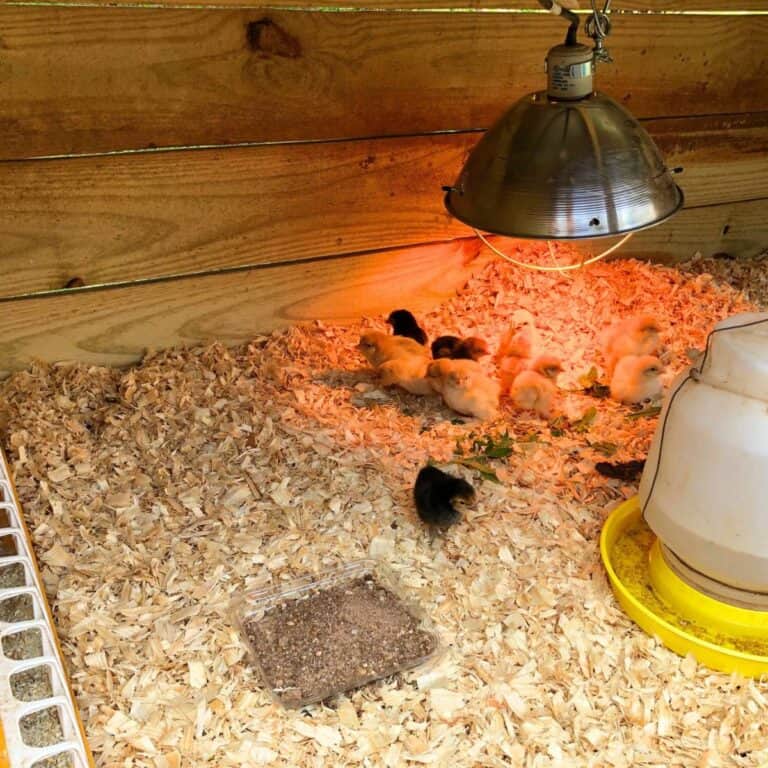
- Keep babies in a brooder up high off the ground for the first 3 weeks. This is because predators are a real issue for most people. So if your brooder happens to be outside, it’s a good idea to keep the brooder high up off the ground for their protection.
- Feed baby turkeys the right food while they are confined. Baby turkeys need a high protein starter. Higher protein than even chick starter. Turkeys need a 30% protein starter, and 14% protein once they’re fully grown. In contrast, chickens need roughly a 20% protein starter (more if they are a meat bird). And they need roughly 15% protein once they’re fully grown and laying eggs.
- Once chickens and turkeys are larger and fully feathered, you can combine the flocks and let them free range outside together. Often they will come back to an open coop to roost together at night. Some of our adult turkeys prefer to roost in tall trees over the coop, though.
- This is hard, but if you have a problem chicken or a problem turkey, consider culling them or confining them. We don’t keep mean chickens or mean turkeys on our farm. We have small children that love to play outside, and it’s too risky to keep mean animals. So when we see a very aggressive rooster or turkey tom (our females have all been docile), we catch them and put them in a coop by themselves until we can harvest them.
If you don’t have a ton of space in your backyard, I wouldn’t recommend raising turkeys. You need enough space to keep your chicken flock and turkey flock happy and healthy. And preferably with enough room to free range so you don’t battle any health issues.
Health Issues
Raising turkeys and chickens together in close quarters can sometimes bring health issues. Poultry keepers need to be on the lookout for any signs of illness, and if you spot it, confine your sick birds away from the rest of the flock.
Just a side note, we haven’t dealt with health issues because we free range our chickens and turkeys on fresh grass and open sunshine. I’m convinced that our birds are healthier because they are not confined except for just a small amount of time during turkey egg-laying season.
Blackhead disease
Blackhead disease (histomoniasis) is a serious, contagious, highly fatal parasitic disease in turkeys. It’s caused by the protozoan Histomonas meleagridis.
It causes severe liver and cecal lesions, leading to yellow diarrhea, lethargy, and a, sometimes, blue-black, drooping head. To prevent this, keep confined areas sanitary to control cecal worms, which cause this disease. Cecal worms are parasitic nematodes that work their way between the small and large intestines of chickens and turkeys.
You may have chickens with cecal worms, and the chickens won’t have any symptoms. Chickens are carriers of this disease. If you put turkeys in confinement with those chickens, chances are good that they’ll develop blackhead disease.
Even if the chickens have left that stationary coop, cecal worm eggs can survive in the dirt for up to four and a half years!

Raising Turkeys
Raising turkeys is pretty straightforward. If you give them fresh air, sunshine, clean water, food, space, a perch, and protection (sometimes from themselves), they will do just fine.
Baby turkeys (poults) have a bad reputation for not being bright and not being able to survive. I will say that some turkeys do seem to lack the common sense that most backyard chickens have, but not all of them.
For example, some of our turkeys will fly over a short fence to forage. But then when they want to get back to the other side (no pun intended), they seem to forget how it’s done. There can be a wide open gate that they walk through to forage, but then they will pace in front of the fence trying to find a hole in the fence to get to the other side instead of walking a bit farther to get to the open gate or flying over.
Other turkeys of the same breed can be extremely intelligent. I’ve had some that became pet turkeys because they were so smart. One pet turkey would fly on top of our air conditioner unit and stare at us through the window. She seemed to be watching what we were saying. She would also walk up to us so we would pick her up and carry her. Another pet turkey would follow us around anywhere we went.
I’ll go over our favorite breeds, hatching turkey eggs, and how we raise them.

Heritage Turkeys
I prefer to raise heritage turkeys instead of the genetically modified meat turkeys available at most hatcheries and farm supply stores. We started with meat turkeys but they seemed to have a lot of health issues. Heritage turkeys are old, standardized breeds that have been around for several decades to several hundred years.
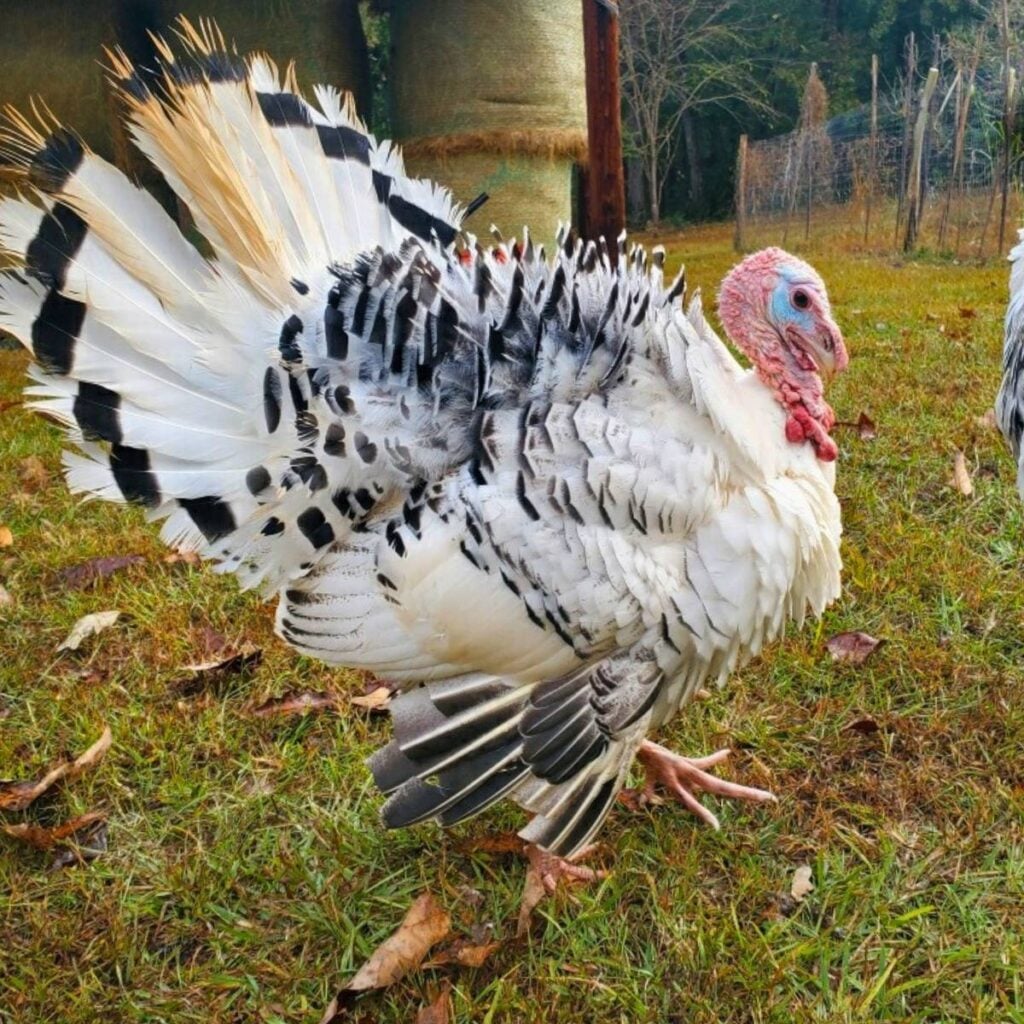
I’ve raised Royal Palm turkeys, Bourbon Red turkeys, and Narragansett turkeys on our farm. They each have their pros and cons. I recommend choosing a breed that will do well in your climate, and that will blend in with your environment.
The white Royal Palm turkeys stuck out like a sore thumb on our farm in central Alabama. They couldn’t blend in with the reds and browns of our forest and pastures, and it seemed like we had more predator attacks. When we switched to Bourbon Red and Narragansett turkeys, our success raising turkeys increased drastically. They were naturally camouflaged in our environment.
Breeding Turkeys
We save our best male turkey (called a tom) and our three best female turkey hens from each breed year to year for breeding. Then we get get new turkey toms to refresh the blood line every other year.
The normal hatch rate for turkeys isn’t as great as with chickens. With chickens, if you incubate fresh farm chicken eggs, you’ll probably get close to a 100% hatch rate. Meaning all the eggs will hatch into healthy baby chicks.
When you hatch turkey eggs, things are less certain. Most of the time, the hatch rate is about 50%. So if you buy turkey eggs from a poultry keeper, be aware that your hatch rate won’t be as high as with chickens. Through selective breeding and intentional incubation processes, we’ve been able to reach about a 70% hatch rate with our turkeys.

Tips for Hatching Turkey Eggs
- If you are breeding heritage turkeys (commercial meat turkeys cannot be bred), collect the eggs every day, clean them up a bit with a dry to slightly damp rag (if necessary), and write the date in pencil along with the breed initial on the shell if you have multiple breeds. (For example, I write “3-5 R” on a Bourbon Red turkey egg added to an incubator on March 5th.) Immediately put the eggs into an incubator. Electric, automatic incubators take all the guesswork out of hatching turkeys. Be sure to use an egg tray for large turkey eggs. Also, don’t soak or wash any eggs you plan on incubating, since doing that will introduce bacteria that may kill a developing baby.
- Point the turkey eggs downward or toward the center of the incubator. The air pocket inside the egg needs to be in the right spot so the baby can develop properly.
- As the turkey eggs come in from the coop, keep adding them to an incubator every day. I have several incubators going before the end of the turkey laying season. Writing the date on the egg is important since the eggs start on different days in the incubator. I also keep a notebook near my incubators so I can keep up with each egg.
- “Candle” the eggs on day 7 to check for veins, which is a sign the egg is fertilized and a baby is growing. If you don’t see any veins or embryonic growth, toss the egg out. It either wasn’t fertilized, or something happened to keep a baby from growing. If you’re not sure, add a question mark in pencil to the egg shell and re-check in another 7 days.
- Keep a separate incubator ready for the last 3 days of hatching. When an egg reaches day 25, I move it to another incubator set to a higher humidity (aim for 70%) and no egg rotating tray. The turkeys start hatching on day 28. Once they start hatching, more babies hatch every day after that until laying season is over.
- Turkey eggs need to be 99.5°F (37.5°C) to hatch in 28 days in the incubator. They also need to have consistent 55-60% humidity for the first 25 days, and around 70% humidity (65% to 75% is fine) for the last 3 days. Also, be sure the eggs don’t turn for the last 3 days so the babies can orient themselves and get in position to hatch.
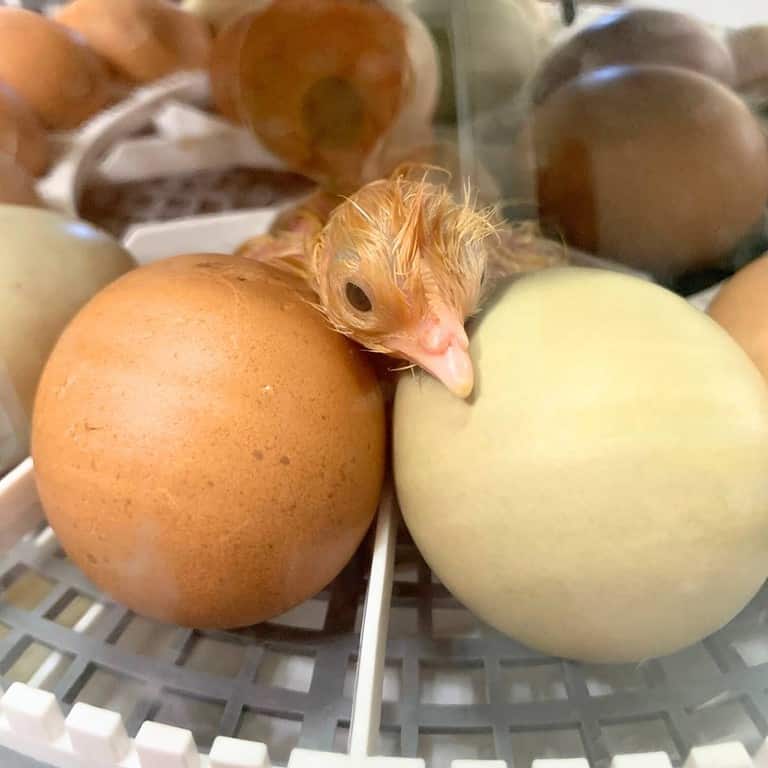
- Once the babies hatch and are dry and fluffy, I take them out of the incubator and give them some special water. I mix a bit of garlic, thyme, and apple scrap vinegar into a little water container and dip their beak in to get their first drink. Then I move them to an outdoor brooder with a heat lamp, some grit, and turkey starter. That’s all they need!
How We Raise Turkeys
When the spring egg laying season starts for our turkeys, we confine our flocks into separate coops. We keep one turkey tom and three turkey hens from each breed. Right now we raise Bourbon Red and Narragansett turkeys. Year after year, we select our best and brightest for breeding.
We incubate our turkey eggs (see tips above), and after the eggs hatch, we move the poults to an outdoor brooder with a heat lamp, food, water, and grit. We keep the babies in the brooder until they’re about 3 weeks old, and then they graduate to a mobile coop on the ground. Most of the time they don’t need the heat lamp because they are fully feathered.

The babies will stay in a mobile coop until they are 6 weeks old, and then they will sometimes graduate to a larger coop until they are 9 weeks old, or until they are large enough to be integrated with our outdoor chickens and turkeys.
Just like with chickens, it’s important to integrate new turkeys into an existing flock (chicken or turkey flock) at night time when all the others are roosting. Then, when they all wake up together the following morning, they are generally accepted by everyone and become part of the family.
Even so, some of our turkeys prefer to roost in tall trees above the chicken coop. That’s fine with us, though.
Raising Chickens
Raising chickens is basically the same as raising turkeys, although they are a bit smarter. If you give baby chicks fresh air, sunshine, clean water, food, space, a perch, and protection, you’ll do alright.
Baby chickens are easily considered one of the most adorable creatures on the planet. They’re like little, alive cotton balls. The chirping and fun antics also make them fun to watch.

Heritage Chickens
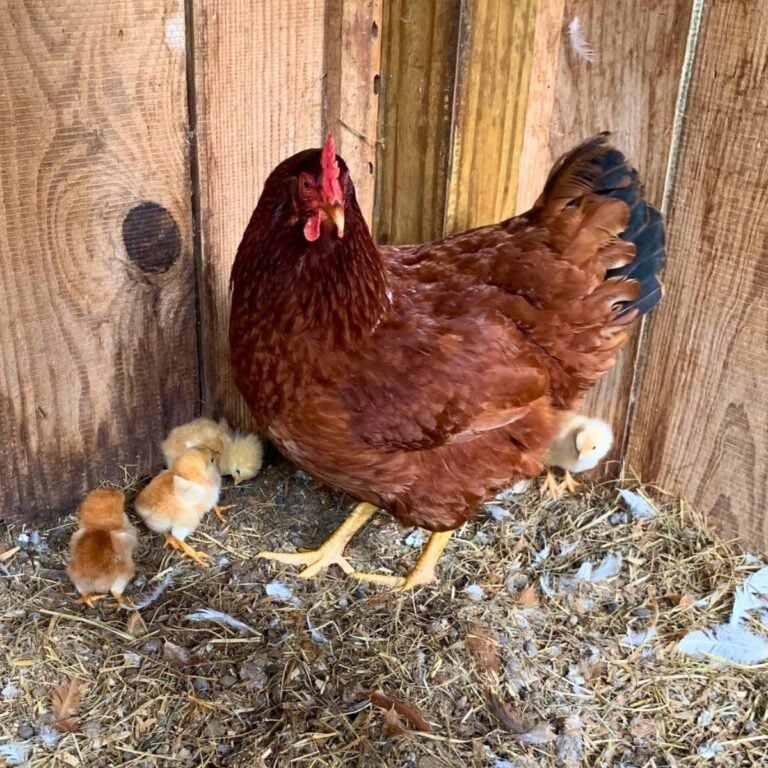
As an experienced backyard chicken keeper, I prefer to raise heritage chickens. They forage for their own food very well, and they seem to survive better. We have a mixed flock of Rhode Island Red, Buff Orpington, Australorp, Barred Rock, and some other breeds.
If you don’t already have a backyard flock, I recommend doing some research in your area and seeing what your neighbors raise. They may even let you have some extra hens plus a rooster so you can start your flock right away. Farmers and homesteaders are some of the nicest people around.
I like breeds that camouflage in well with our surroundings, so we don’t have a lot of pure white chickens left. Also, I prefer the heavier breeds of chickens. Any small chickens are too eager to fly away. Plus, their eggs are tiny and there’s almost no meat on them. Aside from being cute, I don’t see a practical reason for raising them.

Tips for Hatching Chicken Eggs
Chicken eggs need to be 99.5°F (37.5°C) to hatch in 21 days in an incubator. They also need to have consistent 50% humidity for the first 18 days, and around 70% humidity (65% to 75% is fine) for the last 3 days.
We mostly follow the same steps for hatching chicken eggs as we do for hatching turkey eggs. Although, because we have a lot more chicken hens walking around, we generally have enough eggs to fill an incubator at any given time. So we don’t have to shuffle the eggs between different incubators.
I wrote a whole article on how we hatch chicken eggs in an incubator and when to intervene if you want to learn more.
Want to learn about more homestead skills to try? I collaborated with some great people on How to Learn 13 Homestead Skills This Spring!
Frequently Asked Questions
You may have one or two roosters try to mate with a turkey hen, but they can’t really do anything because of the size difference. Turkey toms don’t seem to be attracted to chicken hens, and we’ve never had any issues. Also, turkey toms are anatomically similar to roosters. They perform a “cloacal kiss” rather than penetration. So they won’t be a danger to chicken hens the way that male ducks would be.
If you keep turkeys confined, give them at least 3 square feet of space each so they can move around freely. It’s best to use portable coops for turkeys so they can have fresh greens, bugs, and seeds every day. Also, they prefer to perch up high at night, so go as high as you can.
When we confine our turkeys during egg laying season, we use a chain link dog kennel. My sweet husband added a wood base with wheels so we could easily move it around our pasture. He also used several PVC pipes to make a curved roof, and draped it with canvas so that water and scorching sun wouldn’t be a problem.
In 5 years, our turkeys have not been aggressive to our chickens. If anything, they pal around together while they free range and look for food. If, however, you have an aggressive turkey, I recommend confining the problematic turkey or culling it.
Heritage turkeys are the best to raise with chickens. Commercial turkeys and double breasted turkeys have such a strong appetite, that they will often cause problems when you raise them with chickens. Heritage breeds are more docile, easier to take care of, and they mate naturally.
The best heritage breed for you depends on your climate and surroundings. Choose cold-hardy turkeys or turkeys with a high heat tolerance suitable to your area.
More Chicken and Turkey Posts from the Farm
- How to Hatch Eggs Using an Incubator
- How Much Space Do Chickens Need in a Chicken Coop?
- When is the Best Time to Order Baby Chicks?
- What are straight run chickens? What You Need to Know
- Can Chickens Eat Turkey?